


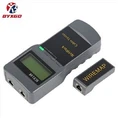


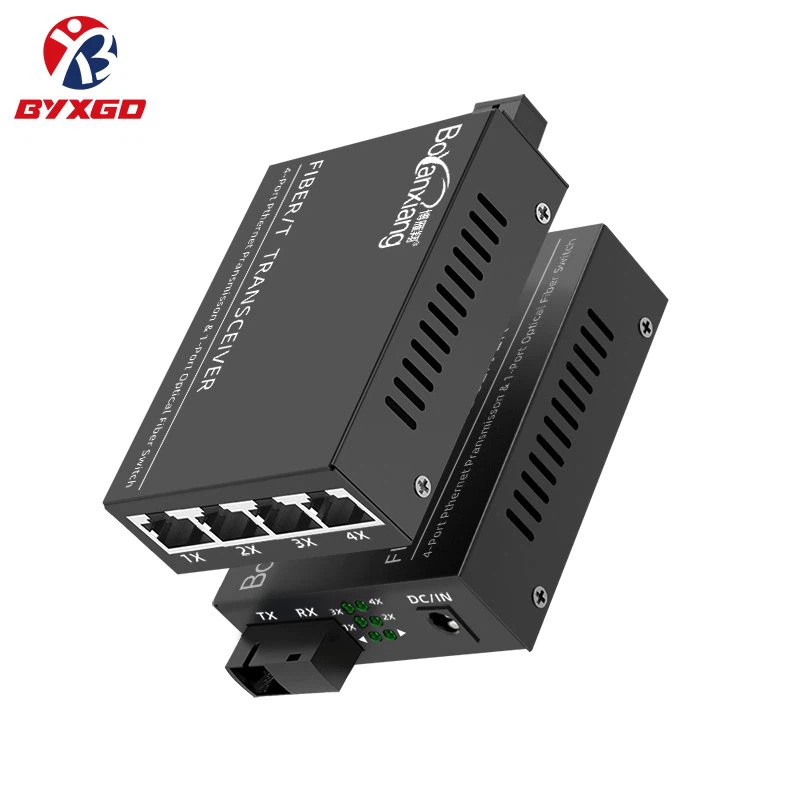
10/100M Fiber Media Converter
What is 10/100M Fiber Media Converter
10/100 Media Converters transparently connect 10Mbps or 100Mbps RJ45 Copper to Fast Ethernet multimode or single mode fiber. The media converter will automatically detect if the copper port speed is 10Mbps or 100Mbps and convert the data rate if the fiber port speed is different.
Benefits of 10/100M Fiber Media Converter
Increased transmission distance
Fiber optic cables can transmit data over much longer distances than copper cables. This makes them ideal for applications where you need to extend the reach of your network, such as in a large office building or campus.
Improved security
Fiber optic cables are less susceptible to electromagnetic interference than copper cables. This makes them a more secure choice for applications where data security is important, such as in financial institutions or government agencies.
Reduced signal loss
Fiber optic cables experience less signal loss than copper cables. This means that you can get better performance over long distances with a fiber optic media converter.
Cost-effective
Fiber optic media converters are a cost-effective way to extend the reach of your network or improve its security.


Why Choose Us
Competitive prices
We offer our products at competitive prices, making them affordable for our customers. We believe that high-quality products should not come at a premium, and we strive to make our products accessible to all.
High quality products
We always put customer needs and expectations in the first place, refine on, continuous improvement, to seek every opportunity to do better, to provide customers with their expectations of quality products, to provide customers with the most satisfactory service at anytime.
Customer satisfaction
Providing after-sales services can enhance customer satisfaction by ensuring that customers' needs are met even after the purchase. This can lead to increased customer loyalty and positive word-of-mouth referrals.
Rich experience
Has a long-standing reputation in the industry, which makes it stand out from its competitors. With over many years of experience, they have developed the skills necessary to meet their clients' needs.
Efficient and convenient
The company has established marketing networks around the world to provide high-quality services to customers in an efficient and convenient manner.
Quality assurance
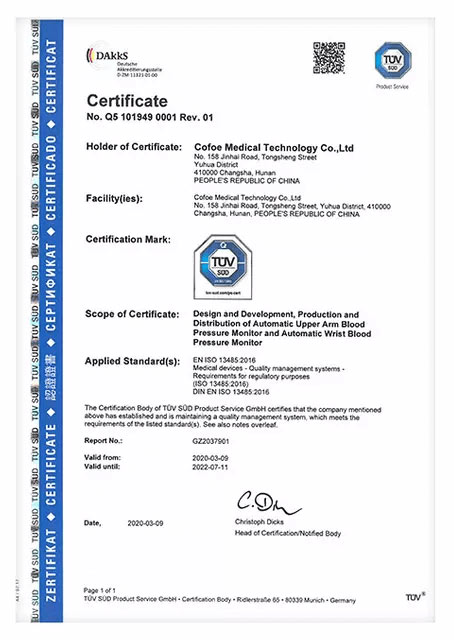
In terms of quality assurance, the company strictly follows the standards and norms of the industry quality system. Adopt industry-leading testing equipment to ensure product quality and good reputation.
What Kinds of Fiber Media Converters Are Available
According to the properties of an optical fiber can be divided into Multimode fiber media converter and Single-mode fiber media converter. Because of the use of different fiber, media converter can transmit the distance is not the same, Multimode fiber media converter general transmit distance between 0.5 km to 2 kilometers, and the single mode fiber media converter coverage can range from 20 km to 120 kilometers.
According to the number of optical fiber required can be divided into Single fiber (WDM) optic media converter, receiving data sent in a single strand fiber transmission; Dual Fiber optic media converter, receiving sent data on a pair of optical fiber transmission.
According to the work level/rate, can be divided into single 10M, 100M fiber media converter, 10/100M adaptive Fiber media converter, and 1000M fiber media converter.
According to the structure, can be divided into desktop (stand-alone) fiber media converter and card-type optical media converter. Stand-alone fiber media converter Suitable for a single user, such as a single switch in the corridor to meet the upper allied. Card-type (modular) optical media converter suitable for multi-user convergence, such as the central room of the community must meet all the switches in the upper allied.
According to network management can be divided into management type optical media converter and non-network management type Optical media converter.
According to the power type can be divided into: internal power optical media converter, the built-in switching power supply for the telecommunications application; external power supply Optical media converter, External transformer power is used in civilian equipment. The former advantage lies in the ability to support the ultra wide power supply voltage, to better achieve voltage regulator, filter, and equipment power protection, reduce the mechanical contact caused by external fault points; the latter has the advantage that the equipment is small and inexpensive.
Divided by the way of work: Full-duplex refers to when data is sent and received streaming, by two different transmission lines, respectively, the communication between the two sides can be sent and received at the same time operation, such a transmission is full duplex system, Full-duplex mode without the direction of the switch, therefore, there is no switching operation caused by the time delay; Half-duplex refers to the use of the same transmission line both as a receiving and sending, although the data can be transmitted in two directions, the communication between the two sides can not send and receive data, such a transmission is half duplex system. In a Half-duplex mode, the transmitter and receiver of each end of the communication system are transferred to the communication line by the receiving/sending switch, and the direction is switched, thus the time delay is generated.

Media converters are simple devices that make it easy to connect different types of networks. However, you still need to be mindful of a few key factors when integrating them into your network. Firstly, it's important to choose a stable, secure location for the media converter and to allow adequate space around it for proper ventilation.
It's also crucial that the transceiver wavelengths of both media converters are consistent. For example, if one transceiver has a wavelength of 1310nm/850nm, the other one should have the same. Furthermore, the data rates of the transceivers and the media converters must match. If you are using 1000BASE SFP transceivers, the media converters should be gigabit. Additionally, it's important to use the same type of transceiver, whether single mode or multimode, on both sides.
The end face of the fiber patch cable should align with the port on the media converter. Typically, SC fiber patch cables are used to connect media converters with SC ports, and LC fiber patch cables are plugged into the SFP/SFP+ ports on fiber media converters. When it comes to transmission, make sure to choose media converters that support full-duplex mode, as using half-duplex mode with full-duplex media converters can result in significant packet loss in the network. It's also essential to maintain the operating temperature within the proper range to avoid any malfunctions.
Fiber Media Converters play a crucial role in bridging the gap between different fiber optic networks, enabling seamless connectivity and enhancing network capabilities. Here are some detailed applications of Fiber Media Converters:
Interconnecting Fiber Networks
Fiber Media Converters are commonly used to interconnect fiber networks that utilize different types of fiber optic cabling, such as single-mode and multimode fibers. By converting the signal from one type of fiber to another, these converters facilitate interoperability and connectivity between diverse fiber networks. This application is particularly useful in environments where network upgrades or expansions require the integration of multiple fiber types to ensure smooth communication and data transmission.
Extending Network Distance
Another key application of Fiber Media Converters is in extending the network distance beyond the limitations of a single fiber link. These converters can be employed to extend the reach of fiber optic networks by converting optical signals and transmitting them over longer distances without signal degradation. By incorporating Fiber Media Converters into the network infrastructure, organizations can overcome distance constraints and establish reliable long-distance connections between network segments or remote locations.
Network Migration
Fiber Media Converters are essential tools for network migration projects that involve transitioning from legacy fiber technologies to newer fiber optic standards. During network upgrades or technology transitions, these converters facilitate the integration of existing fiber infrastructure with modern fiber systems. By converting signals between different fiber types or standards, Fiber Media Converters enable a seamless migration process, allowing organizations to leverage the benefits of advanced fiber technologies without the need for costly infrastructure overhauls.
Compatibility Enhancement
Fiber Media Converters enhance compatibility between various fiber optic devices and components within a network ecosystem. They enable the conversion of different optical interfaces, wavelengths, or transmission speeds, ensuring that disparate network elements can communicate effectively with each other. By supporting a wide range of fiber types and configurations, these converters promote interoperability and flexibility, enabling organizations to build versatile and scalable fiber optic networks that can adapt to evolving requirements and technologies.
Factors to Consider During Fiber Media Converters Selection
To select the right fiber media converters for your project, many elements should be considered. You should firstly consider where you want to use fiber media converters and how to use them. Then, you should know the functions and characters of fiber media converters. The following will list some important factors that should be considered during fiber media converters selection.
Data Rate: The speed of the devices that fiber media converter is to connect to should be firstly considered. The most commonly used are 10/100Mpbs (fast etherenet), 10/100/1000Mpbs, 1000Mpbs (Gigabit ethernet).
Fiber Type: Which two different types of transmission medias should be converted between each other? For example, fiber optic to copper, single-mode fiber optic to multimode fiber optic, dual strand or single strand, etc.
Wavelength: To add the fiber media converters to a fiber optic network, the wavelength that the signal should be specified to the network and the devices.
Fiber port Type: Fiber media converter also has various port types. The most commonly used types for fiber optic on the fiber media converters are SC, FC and LC (SFP slot). The number of the power should depend on the applications.
Transmission Distance: The transmission distances of a pair of fiber media converter are also various and can satisfy various requirements from 2km to 15km or more.
PoE Function: PoE fiber media converter can fully satisfy the need to be powered in physical locations where main power is not available or difficult to deliver.
Power Requirement: The most commonly used are AC power supply, DC power supply,, internal power supply, and external power supply.
There are currently two ways to distinguish the two media converters.
When the fiber media converter is embedded with an optical module, it is divided into single-fiber media converter and dual-fiber media converter according to the number of fiber cores of the connected optical fiber jumper. The fiber jumper connected to single-fiber media converter(on the right) has one fiber core, which is responsible for both transmitting and receiving data; the fiber jumper connected to dual-fiber media converter(on the left) has two cores, one of which is responsible for transmitting data and the other is for receiving data.
When the fiber media converter does not have a built-in optical module, we can distinguish whether it is single-fiber media converter or dual-fiber media converter according to the inserted optical module. When a single-fiber bidirectional optical module is inserted into the fiber media converter, that is, when the interface is simplex type, the fiber media converter is a single-fiber media converter (on the right); When a dual-fiber bidirectional optical module is inserted into it, that is, when the interface is of duplex type, it is a dual-fiber media converter (on the left).
How to Fix Fibre Media Converter Problems
Once you have diagnosed the problem with your fibre media converter, there are several steps to take that should resolve the issue:
Check the power connection to the fibre media converter
In short, make sure that the converter is connected properly to the power source. Replace or reconnect any faulty power cables or adapters if necessary.
Reset the configuration settings of the fibre media converter
If you suspect incorrect configuration settings, then you should reset the fibre media converter to its factory results. To do this properly, you should refer to the user manual or the manufacturer’s website for instructions on how to perform a reset.
Update the firmware of the fibre media converter
If the outdated firmware is the culprit of the poor performance, then update the converter’s firmware to the latest version. You should follow the instructions from the manufacturer to ensure a smooth and successful update process.
Our Factory
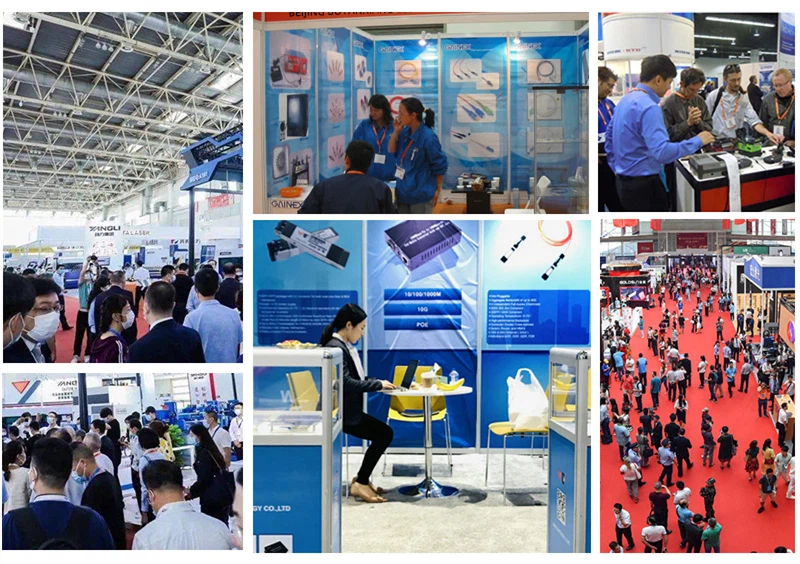
Babaolu (Shenzhen) International Technology Co., Ltd. founded in September 24, 2009 in Haidian District, Beijing, is a franchise fiber network products enterprise, products are optical fiber tools and accessories (optical power meter, red light pen, fiber jumper, tail fiber, optical power red light integrated machine cold connector, transceiver, Optical time domain reflectometer (OTDR), optical fiber found disabled apparatus, network tester, fast connection, cold pick up tools, etc.) product development and sales business.

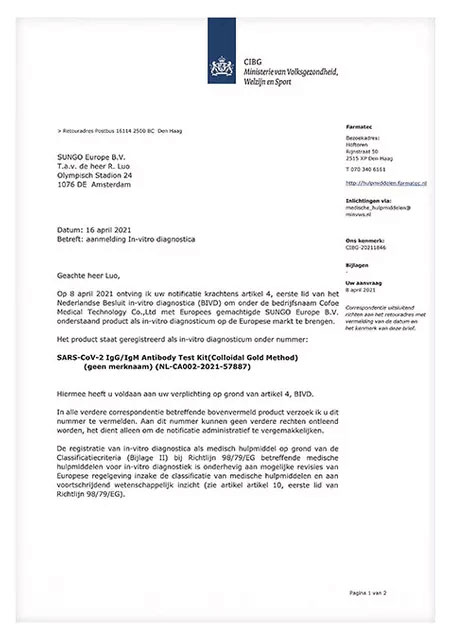
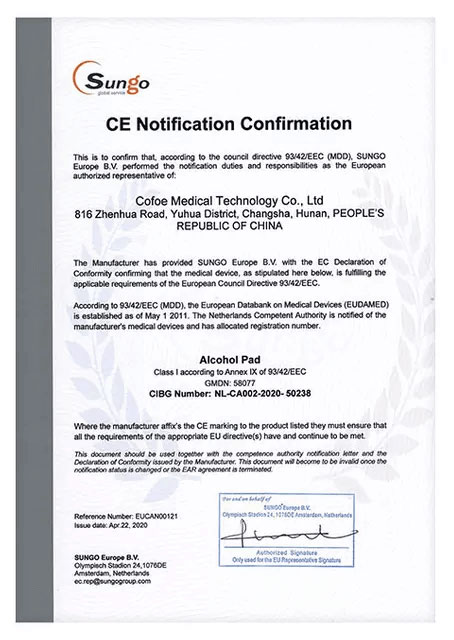
Certifications

FAQ
As one of the most professional 10/100m fiber media converter manufacturers and suppliers in China, we're featured by quality products and good service. Please rest assured to buy 10/100m fiber media converter at competitive price from our factory.
single mode multimode fiber, Jumper mm, jumper lszh